 EN
EN

The Stainless Steel Problem in Wastewater Corrosion
A sewage treatment plant managing 50,000 cubic meters of municipal wastewater daily operates in a chemically aggressive environment. Primary clarifier effluent contains 150 to 400 mg/L chloride ions from domestic water softening, industrial discharge, and road-salt runoff. Secondary treatment introduces hydrogen sulfide generated by anaerobic sludge digestion — concentrations of 5 to 50 ppm in the headspace above sedimentation tanks convert to sulfuric acid via biological oxidation on any surface above the waterline. This environment attacks stainless steel in ways its name — "stainless" — misleads engineers into believing it will not corrode.
Chloride Pitting, Hydrogen Sulfide Attack, and Galvanic Corrosion in Clarifier Environments
Three corrosion mechanisms degrade stainless scraper components in a sewage treatment plant. Chloride pitting — chloride ions penetrate the passive chromium oxide layer on 304 stainless above 100 mg/L when water temperature exceeds 30°C, creating pits that become through-wall perforations within 2 to 4 years. 316 stainless, with molybdenum, resists pitting at higher concentrations but costs 40% to 60% more and corrodes at weld zones where the heat-affected zone loses molybdenum. Hydrogen sulfide attack — H₂S converts to sulfuric acid via Thiobacillus bacteria on tank walls above the waterline, producing pH as low as 1.0 to 2.0. This acid dissolves the iron matrix, leaving a weakened structure that fails under mechanical load. Galvanic corrosion at every stainless-to-mild-steel connection — a 304 scraper chain pin against a carbon steel sprocket creates a galvanic cell, accelerating sprocket wear by 3× to 5×.
Real-World Case — A Municipal Plant's 18-Month Scraper Chain Failure
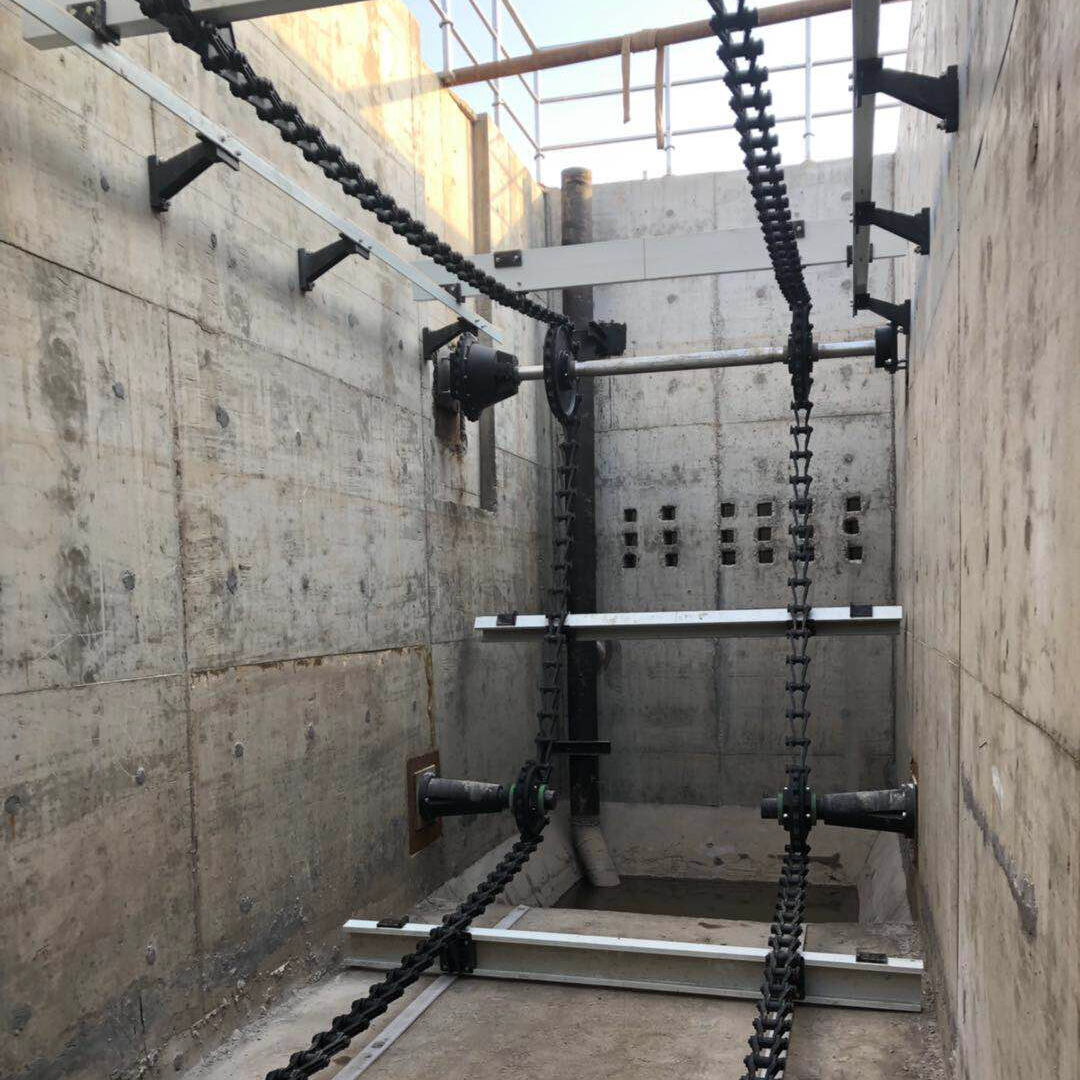
A municipal sewage treatment plant in a coastal region of Southeast Asia replaced its primary clarifier scraper chains with 304 stainless in 2021. By mid-2023 — 18 months into service — chain links at the waterline showed visible pitting, and three links fractured, dropping the scraper flight into the clarifier and requiring a four-day shutdown for crane-assisted retrieval. Water analysis showed 280 mg/L chloride and 12 ppm H₂S in the headspace. The plant replaced the entire system with composite scraper components from HSHUAKE (Hengshui Huake Rubber & Plastic), a manufacturer with 18 years of experience in non-metallic sludge scraper systems serving 100+ countries. The replacement chain — glass-fiber reinforced engineering plastic with UV-stabilized formulation — showed zero corrosion, zero weight loss, and zero mechanical degradation after 24 months. The plant has since converted two additional clarifiers.
Composite Materials — Cost, Lifespan, and Performance
FRP and Engineering Plastics vs 304 and 316 Stainless — A Side-by-Side Analysis
A sewage treatment plant comparing composite scraper components to stainless evaluates four parameters. Corrosion resistance — engineering plastics (PA6 with glass fiber, UHMWPE, POM) and FRP are inert to chloride, hydrogen sulfide, and sulfuric acid across the full range of wastewater chemistry. Lifespan — properly formulated composite scraper chains last 10 to 15 years in municipal wastewater, 3 to 5 times the 2-to-4-year life of 304 stainless in aggressive conditions. Weight — composites weigh 60% to 75% less. A composite scraper flight weighing 8 kg replaces a 25 kg stainless flight. Initial cost — engineering plastic scraper components cost 15% to 30% less than 304 stainless and 40% to 55% less than 316 stainless per component.
Energy and Maintenance Cost Comparison
Drive Motor Sizing, Wear Component Replacement, and Labor Reduction
The weight reduction of composite scraper components in a sewage treatment plant produces three savings. Drive motor sizing — composites require a 30% to 40% smaller motor. A 2.2 kW motor replaces a 3.7 kW motor, saving 13,000 kWh annually (approximately €1,600). Sprockets driving composite chains last 2× to 3× longer without galvanic couples. Composite components are lifted by two workers without a crane, reducing annual maintenance labor by 40 to 60 person-hours per clarifier.
Installation and Retrofit Practicalities
Weight Reduction, Modular Assembly, and Compatibility with Existing Tank Structures
Retrofitting a sewage treatment plant from stainless to composite scraper components does not require structural modifications. Composite components are modular — chain links, flight sections, and scraper blades assemble with pin-and-cotter connections using basic hand tools. A 40-meter clarifier that required a 50-ton mobile crane for stainless installation can be serviced with scaffolding and manual lifting. Composite systems are custom-dimensioned to tank length, width, and water depth, matching existing sprocket center distance so the retrofit uses the existing drive system with only a motor downsizing change.
Frequently Asked Questions
How much does switching to composite scrapers save a sewage treatment plant?
A sewage treatment plant switching from 304 stainless to composite scraper components saves 15% to 30% on initial component cost, 30% to 40% on drive motor energy, and eliminates replacement cycles that occur every 2 to 4 years with stainless in aggressive wastewater. HSHUAKE has supplied non-metallic scraper systems to plants in over 100 countries.
How long do composite scraper components last in wastewater?
Composite scraper components in a sewage treatment plant last 10 to 15 years — 3 to 5 times longer than 304 stainless in aggressive chloride and H₂S conditions. HSHUAKE provides extended coverage on its non-metallic scraper systems.
Are composite scrapers as strong as stainless steel?
Yes. Glass-fiber reinforced engineering plastics used in sewage treatment plant scraper systems have a tensile strength of 150 to 220 MPa — comparable to or exceeding the yield strength of 304 stainless (205 MPa) at approximately 75% less weight.
What causes stainless steel to corrode in sewage treatment plants?
Chloride pitting above 100 mg/L, hydrogen sulfide conversion to sulfuric acid by Thiobacillus bacteria, and galvanic corrosion at stainless-to-carbon-steel connections cause stainless scraper failure in a sewage treatment plant within 2 to 4 years.
Can composite scrapers be retrofitted into existing clarifiers?
Yes. Composite scraper components for a sewage treatment plant are custom-dimensioned to the existing tank, matching sprocket center distance and flight spacing. Installation uses basic hand tools with no crane access required.
What maintenance do composite scraper systems require?
Composite scraper systems in a sewage treatment plant require annual visual inspection of chain tension, sprocket tooth wear, and flight condition. No corrosion protection, painting, or cathodic protection is required — the material is inherently inert to wastewater chemistry.