 EN
EN

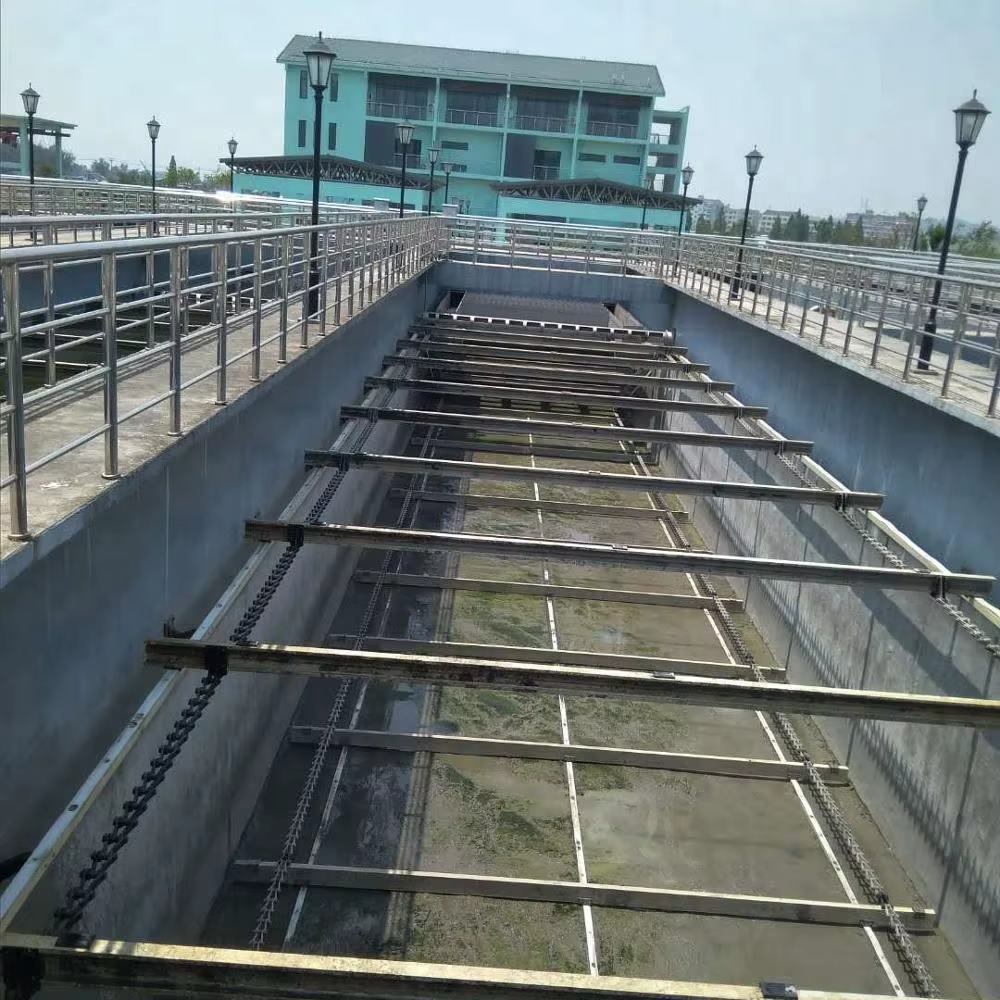
The TCO Gap: Metal vs Non-Metallic Mud Scrapers in Five Years of Corrosive Service
A mud scraper operating in a sedimentation tank with pH below 4 and hydrogen sulfide above 50 ppm consumes its purchase price in maintenance costs within the first three years if it is built from metal. The same mud scraper built from non-metallic materials — UHMW-PE flight surfaces, GRP structural members, PA66 guide brackets — accumulates maintenance costs totaling roughly 15% of purchase price over the same period. The total cost of ownership (TCO) gap between metal and non-metallic scrapers in corrosive environments is not marginal — it is a factor of five to seven times over a five-year lifecycle, with the gap widening each subsequent year as metal degradation accelerates.
The procurement decision often focuses on the initial capital cost comparison: a carbon steel scraper system priced at 25,000–40,000 versus a non-metallic system at 35,000–55,000. The 30–40% premium for non-metallic materials appears difficult to justify in a budget review that stops at the purchase order. Extending the analysis to five years of actual operating costs — maintenance labor, replacement parts, production downtime during repairs, and the safety overhead of confined-space entry for each intervention — reverses the calculation decisively in favor of non-metallic.
Where the Money Goes: Five-Year Cost Breakdown
Metal Scraper: The Escalating Maintenance Curve
Year one of a carbon steel mud scraper in moderately corrosive conditions (pH 5–7, H2S 5–20 ppm) typically passes with routine quarterly inspections and minor chain tension adjustments — maintenance costs of 2,000–4,000. Year two introduces blade-edge replacement as pitting corrosion compromises the scraping edge — adding 8,000–12,000. Year three brings chain-link replacement at corrosion-affected joints — another $10,000–15,000 including the downtime cost of draining the clarifier for 3–5 days.
By year five in aggressive conditions (pH <4, H2S >50 ppm), the cumulative maintenance expenditure on a metal mud scraper typically reaches 180–250% of the original purchase price. The Water Treatment Digest documented a petrochemical plant case where carbon steel scraper maintenance over 18 months in a pH 1.8–2.4 primary sedimentation tank totaled $184,000 — more than four times the system's replacement cost.
Non-Metallic Scraper: The Flat Maintenance Line
Non-metallic scrapers eliminate the corrosion-driven maintenance escalation. UHMW-PE flight surfaces lose material at less than 0.05 mm per year in sulfide-rich environments — a rate that produces measurable but functionally irrelevant wear over a decade of operation. GRP structural frames experience zero corrosion because glass fiber and polyester/vinyl ester resin matrices are electrochemically inert — there is no metal to oxidize.
The annual maintenance requirement for a non-metallic mud scraper consists of visual inspection of chain tension, sprocket tooth condition, and flight surface integrity — approximately $500–1,000 in labor per year for a standard rectangular clarifier installation. Chain tension adjustment, the most common intervention, is performed through the system's integral tensioning mechanism without tank draining or confined-space entry. Hengshui Huake Rubber & Plastic's non-metallic chain scraper systems are designed with modular, bolt-together components that allow individual flight or chain-link replacement without dismantling the entire assembly — a feature that further reduces the labor cost of the infrequent repairs that do occur.
Downtime: The Hidden Line Item
Every day a primary clarifier operates without its mud scraper, solids accumulate on the tank floor, reducing effective retention time and increasing the load on downstream treatment stages. If the accumulated sludge goes anaerobic, hydrogen sulfide concentrations spike, accelerating corrosion of any remaining metal components and creating odor complaints from neighboring communities.
Metal scraper repairs typically require 3–5 days of clarifier downtime per intervention — draining, confined-space entry, component replacement, refilling, and process restabilization. At three interventions over five years, the cumulative downtime reaches 9–15 days. Non-metallic scraper interventions — primarily chain tension adjustments — require 2–4 hours without draining the tank. Over five years, the downtime difference between metal and non-metallic systems can exceed 10 operational days — a cost that treatment plant operators understand viscerally even when it does not appear in procurement spreadsheets.
Real-World TCO Validation
A municipal water authority in the Middle East operating four primary sedimentation tanks replaced two carbon steel mud scraper systems with non-metallic chain scraper systems from Hengshui Huake while retaining two metal systems as a comparison baseline. After 4 years of parallel operation — identical wastewater chemistry, identical tank geometry, identical operating schedules — the non-metallic systems had accumulated 3,200 in combined maintenance costs (chain tension adjustments and one sprocket replacement due to a foreign-object jam). The metal systems had accumulated 87,000 in combined maintenance and repair costs, including two complete flight assembly replacements and one drive shaft replacement due to stress corrosion cracking.
The procurement premium for the non-metallic systems — approximately $14,000 per tank — was recovered through maintenance-cost avoidance within 18 months. The continuing savings became pure operational budget relief in years three and beyond.
Frequently Asked Questions
How do I calculate TCO for a mud scraper in my specific conditions?
Calculate the purchase price plus five-year projections for: scheduled maintenance labor, replacement parts (blades, chains, sprockets), unscheduled repair labor, downtime cost (lost treatment capacity), and confined-space entry safety overhead. Request maintenance-cost data from manufacturers specific to your wastewater chemistry — Hengshui Huake provides application-specific TCO projections based on pH, H2S concentration, chloride levels, and operating temperature.
At what corrosion severity does non-metallic become clearly cheaper?
The TCO crossover point occurs at approximately pH 6 and H2S 5 ppm — conditions where 316L stainless steel shows measurable pitting within 24 months. Below pH 5 or above H2S 20 ppm, non-metallic scrapers produce 60–80% lower five-year TCO. In extreme conditions (pH <3, H2S >100 ppm), the TCO advantage exceeds 80%.
Can non-metallic scrapers match the mechanical strength of steel?
GRP structural components achieve tensile strength of approximately 290 MPa — comparable to aluminum alloys — while weighing 75% less. The strength-to-weight ratio of GRP exceeds that of carbon steel. UHMW-PE flight surfaces sacrifice some stiffness relative to steel but compensate through superior wear resistance and the elimination of corrosion-induced strength loss over time.
What is the lead time for non-metallic scraper replacement parts?
Standard components (chain links, sprockets, flight attachments) ship within 2–4 weeks from manufacturers maintaining production inventory. Hengshui Huake stocks standard 152.4mm pitch chain components and NH78 sprockets for immediate availability. Custom or tank-specific components may require 4–6 weeks.
Do non-metallic scrapers require special installation procedures?
Installation is generally simpler than metal systems because components are lighter (modular sections weigh 15–25 kg versus 40–60 kg for steel equivalents) and assemble with mechanical fasteners rather than welding. Hengshui Huake provides installation manuals and can dispatch technicians for on-site supervision. Most installations complete within 3–5 working days for a standard rectangular clarifier.
How do I verify the polymer grade in my scraper components?
Request mill test certificates from the manufacturer identifying the polymer type, grade, and molecular weight for UHMW-PE components. Independent laboratory verification of a retained sample is recommended for first-time procurement. Hengshui Huake's ISO 9001-2008 quality system documents material traceability from resin supplier to finished component.