 EN
EN

Breaking the Failure Cycle: Why Non-Metallic Chain Scraper Systems Outlast Metal by Years
A scraper system that fails every few months is not an anomaly — it is a predictable consequence of operating metal chain and flight components in an environment chemically engineered to destroy metal. The wastewater in a primary clarifier contains hydrogen sulfide, chlorides, organic acids, and abrasive grit — a four-way attack on carbon steel that pits surfaces, corrodes weld joints, erodes bearing surfaces, and stress-cracks loaded components. The failure mode is built into the material choice.
A non-metallic chain scraper system — UHMW-PE flights driven by GRP-reinforced chains on PA66 sprockets — eliminates each failure mechanism at the material level. The chain does not corrode because there is no metal to oxidize. The sprocket teeth do not pit because PA66 is chemically inert in the pH and chloride ranges found in wastewater. The flight surfaces do not lose scraping-edge geometry because UHMW-PE wears at 0.05 mm per year instead of 1.0 mm per year for stainless steel. A scraper system that fails because of material degradation can only be fixed by changing the material — not by increasing inspection frequency or stocking more spare parts.
Why Metal Chain Scraper Systems Fail
Chain Elongation from Corrosion-Wear Synergy
Every metal chain link in a scraper system experiences wear at two contact points: the pin-to-bushing interface where the link articulates, and the bushing-to-sprocket interface where drive torque transmits. In clean, lubricated conditions — a conveyor in a dry factory — this wear progresses slowly and predictably. In a wastewater clarifier, the same interfaces operate submerged in water carrying dissolved sulfides and suspended grit. The sulfide attacks the metal surface at the microscopic level, creating a softened, chemically altered layer that the grit then abrades away — a corrosion-wear synergy that accelerates material loss far beyond what either mechanism would produce alone.
Chain elongation of 2–3% over 6–12 months is common in metal scraper systems operating in moderate corrosion conditions. At 3% elongation, the chain skips sprocket teeth, the flights lose timing synchronization, and the scraper stops transporting sludge effectively. The repair requires draining the clarifier, extracting the chain, replacing elongated sections, and retensioning — a 3–5 day downtime event that repeats every 6–12 months for the scraper system's service life.
Sprocket Tooth Erosion
Metal sprockets in wastewater scraper systems wear through a combination of corrosion pitting at the tooth flank and abrasive wear from chain contact. Once pitting creates a rough surface on the tooth flank, each chain engagement removes additional material — the rough surface acts as a file against the chain bushing. A sprocket tooth that loses 15–20% of its profile depth no longer reliably engages the chain, producing the characteristic "jumping" sound and erratic flight movement that precedes complete drive disengagement.
Non-metallic sprockets — Hengshui Huake's NH78 series molded from PA66 with glass fiber reinforcement — resist pitting because PA66 is chemically inert in the pH 4–10 range. The material's inherent lubricity reduces chain-to-sprocket friction, lowering both wear rate and drive motor current draw. The sprocket teeth maintain their profile geometry through the scraper system's design life because the dominant wear mechanism — corrosion-assisted abrasion — is eliminated.
The Non-Metallic Chain Scraper Architecture
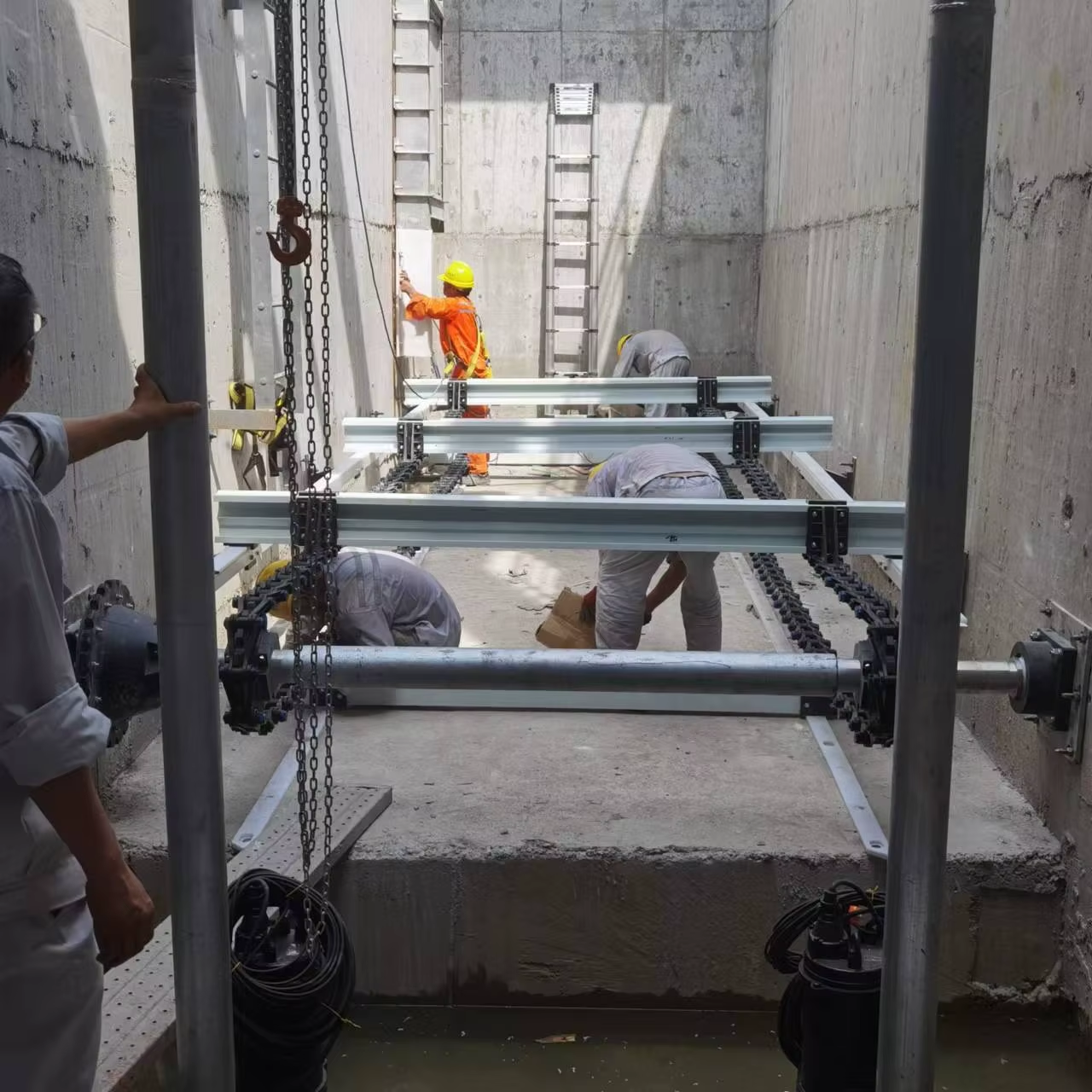
A non-metallic chain scraper system from Hengshui Huake Rubber & Plastic replaces every corrosion-susceptible component with a polymer equivalent:
- Chain links: High-strength engineering polymer with 152.4 mm pitch, corrosion-proof, self-lubricating — no grease required, no rust possible
- Flight surfaces: UHMW-PE blades attached to chain links at regular intervals, scraping settled sludge along the tank floor toward the collection hopper
- Sprockets: NH78 non-metallic sprockets molded from glass-reinforced PA66, maintaining tooth profile without pitting or abrasive wear
- Guide rails and brackets: PA66 components that provide chain guidance without the galvanic corrosion that occurs at steel-on-steel guide interfaces
The system design is modular and stackable — multi-layer configurations scrape from both top and bottom in a single pass, handling floating scum and settled sludge simultaneously. Installation requires no welding; components bolt together in the drained tank using standard hand tools. The lightweight design (GRP structural members weigh 75% less than steel equivalents) allows assembly without crane access in most clarifier configurations.
A Maintenance Manager's Perspective
The operations team at a chemical park wastewater treatment facility in Uzbekistan had normalized scraper system failure as an operating cost — budgeting 45,000 annually for chain replacements, sprocket replacements, and the overtime labor to perform repairs during weekend shutdown windows. After replacing two rectangular clarifier scraper systems with Hengshui Huake non-metallic chain scrapers, the annual maintenance budget for those clarifiers dropped to 3,500 — covering visual inspections and one chain tension adjustment. The facility's maintenance manager noted that the most significant operational change was not the cost reduction but the elimination of emergency repairs — the scraper system stopped being the primary source of unscheduled downtime.
Frequently Asked Questions
How often should a non-metallic chain scraper system be inspected?
Annual visual inspection is sufficient for municipal wastewater conditions. Industrial facilities with high grit loading or extreme pH may benefit from semi-annual inspections. The inspection checks chain tension, sprocket tooth condition, flight attachment integrity, and guide rail alignment — all achievable without tank draining.
What causes chain elongation in non-metallic systems?
Non-metallic chains experience minimal elongation because the dominant causes of metal chain elongation — corrosion-wear synergy and link deformation — are absent. Any elongation that occurs over years of operation results from gradual wear at the pin-bushing interface, which is self-lubricating in polymer chains. Tension adjustment compensates for this wear.
Can non-metallic chain systems handle the same sludge loads as metal?
Yes — GRP structural members maintain tensile strength of approximately 290 MPa, and the chain link design distributes the pulling load across the full cross-section. Hengshui Huake's scraper systems are engineered for sludge loads up to the equivalent of the rectangular tank's design capacity, with the drive motor sized accordingly.
Are replacement chain links and flights stocked by the manufacturer?
Standard 152.4 mm pitch chain components and UHMW-PE flight attachments are stocked for immediate shipment. Hengshui Huake maintains production inventory of chain links, sprockets (NH78), flights, and guide rail brackets — replacement parts ship within 2–4 weeks of order.
How long does installation of a non-metallic chain scraper system take?
A standard rectangular clarifier scraper system installs in 3–5 working days with a crew of 2–3 technicians. The bolt-together modular design eliminates welding time. Hengshui Huake provides on-site installation supervision to ensure correct assembly sequence, chain tension, and sprocket alignment.
What is the power consumption advantage of non-metallic systems?
The lower weight of non-metallic components (75% lighter than steel) reduces the drive motor's continuous current draw by approximately 15–25% compared to equivalent metal scraper systems. The self-lubricating polymer chain further reduces friction losses. Over a 10-year operating life, the energy savings alone offset a meaningful portion of the scraper system's purchase cost.