 EN
EN

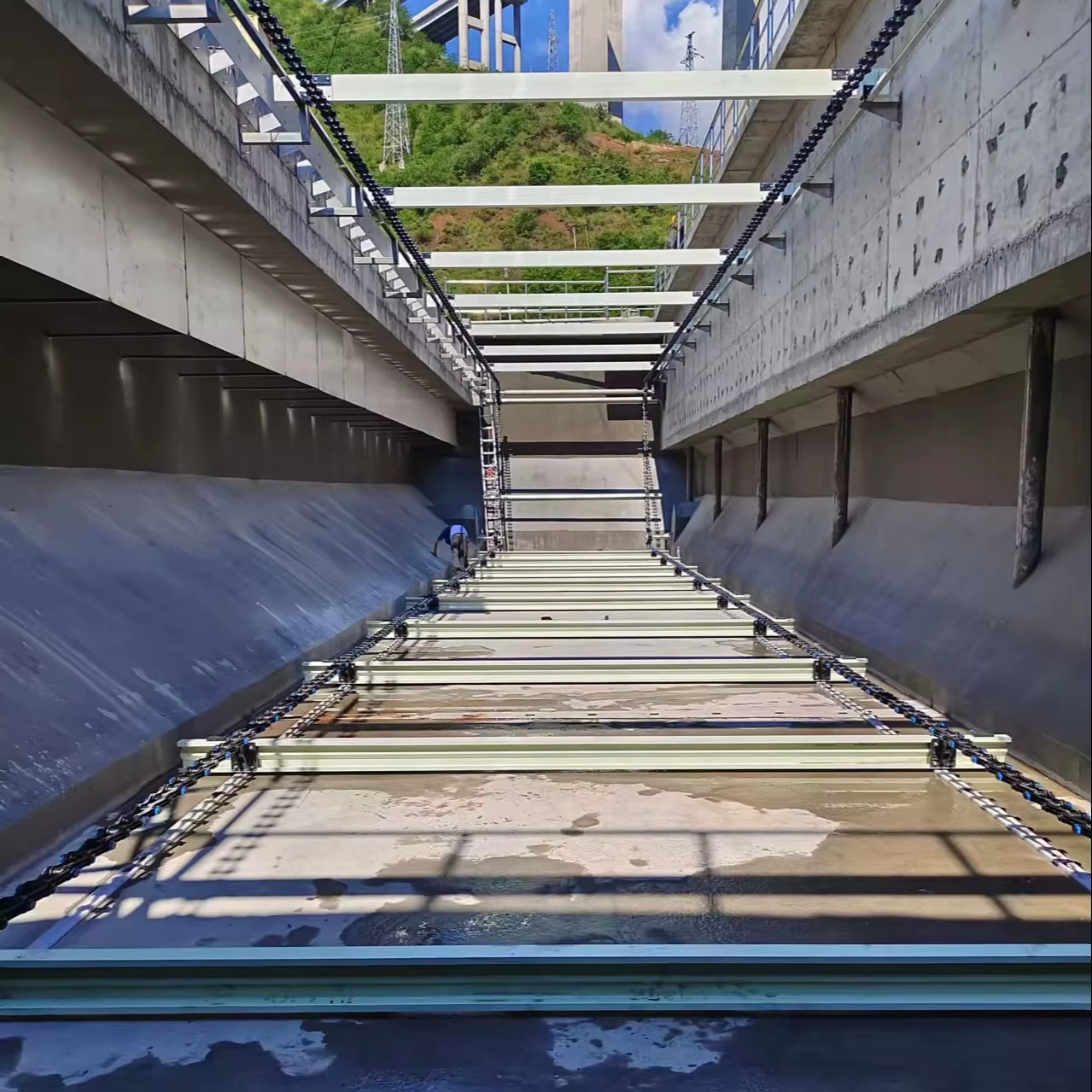
The Corrosion Clock: When a Sludge Scraper Rusts Faster Than It Cleans
Every metallic sludge scraper installed in a wastewater treatment plant carries an invisible expiration date. The countdown begins the moment hydrogen sulfide concentrations in the headspace exceed 5 ppm — a threshold reached in roughly 80% of municipal primary clarifiers within their first year of operation. Sulfide gas dissolves into the condensation film on metal surfaces, forming sulfuric acid micro-droplets that pit stainless steel at rates of 0.8–1.2 mm per year. A scraper blade that starts at 6 mm thickness reaches structural failure territory within 3–4 years — and that timeline shrinks to 18–24 months in industrial wastewater with pH below 4.
A sludge scraper built from non-metallic materials — UHMW-PE, glass fiber reinforced polymer (GRP), PA66 — simply does not participate in this chemical reaction. The material loss rate for UHMW-PE flight surfaces in sulfide-saturated environments measures below 0.05 mm per year, according to EPA monitoring data from 2022. A scraper that loses 0.05 mm annually takes 100 years to lose 5 mm — effectively immune to the mechanism that kills metal scrapers.
How Corrosion Destroys Metal Scrapers
Three Attack Vectors Working Simultaneously
Metal scraper degradation is not a single process but three concurrent mechanisms. Chemical pitting creates microscopic cavities where chloride ions concentrate — each pit becomes a corrosion accelerator, deepening at rates proportional to the chloride concentration. Galvanic corrosion attacks weld points and dissimilar-metal joints, where the electrochemical potential difference between the weld filler and the base metal creates a miniature battery that consumes the anode. The Ponemon Institute documented in 2023 that galvanic corrosion at weld points alone accounts for 62% of metallic scraper replacements in aerated grit chambers.
The third mechanism — stress corrosion cracking — combines the chemical attack with the mechanical load of dragging sludge across a tank floor. Torsional stress on scraper shafts creates micro-fractures that corrosive media penetrate, reducing structural integrity by 40–60% before visible damage appears. Carbon steel scrapers operating at pH fluctuations below 4 see their expected 10-year service life collapse to 18–24 months.
The Maintenance Spiral
When a metal scraper begins corroding, maintenance frequency escalates exponentially. Quarterly inspections become monthly. Monthly become weekly. Each intervention requires draining or bypassing the clarifier, deploying confined-space entry teams, and replacing blade sections — a cycle costing $40,000–180,000 annually in unplanned maintenance for a mid-sized municipal plant, based on the petrochemical case data reported by Water Treatment Digest.
The Non-Metallic Alternative
Non-metallic scrapers eliminate the corrosion mechanism entirely. UHMW-PE (ultra-high molecular weight polyethylene) flight surfaces resist chemical attack from hydrogen sulfide, chlorine concentrations below 500 ppm, and pH conditions ranging from strongly acidic to alkaline. The material's self-lubricating surface reduces friction through sludge by approximately 40% compared to steel — less drag means lower motor current draw, reduced chain tension, and measurable energy savings over the system's operating life.
GRP (glass fiber reinforced polymer) structural components weigh one-quarter of equivalent steel sections while maintaining tensile strength around 290 MPa. The weight reduction cascades through the entire drive system: lighter scrapers require smaller motors, lighter chains, and lower-torque sprockets — all of which reduce both capital cost and ongoing energy consumption.
Hengshui Huake Rubber & Plastic Co., Ltd. manufactures these non-metallic scraper systems at two production facilities totaling over 10,000 square meters, with 18 years of specialized experience. The company's NH78 non-metallic sprocket and 152.4mm pitch chain scraper systems operate in rectangular settling tanks across more than 100 countries. The chain and flight assemblies arrive as modular, stackable components that install without welding or heavy lifting equipment — a design choice that reduces installation time by approximately 30% compared to welded steel alternatives.
Real-World Application
A municipal wastewater treatment plant in central Germany replaced its 316L stainless steel primary clarifier scrapers — which had required blade replacement every 26 months due to sulfide pitting — with a complete non-metallic chain scraper system. After 4 years of continuous operation at H2S concentrations averaging 12 ppm in the headspace, the UHMW-PE flight surfaces showed material loss below 0.2 mm total — equivalent to 0.05 mm/year. Maintenance interventions dropped from quarterly to annual visual inspections. The plant's operations manager reported that the single largest operational benefit was the elimination of confined-space entry for mid-cycle scraper repairs — a safety improvement that justified the investment independently of the cost savings.
Frequently Asked Questions
What materials are non-metallic sludge scrapers made from?
Non-metallic scrapers use engineering polymers including UHMW-PE for flight surfaces, GRP for structural frames, PA66 for guide rail brackets, and HDPE or PU for wear components. Hengshui Huake's scraper systems combine these materials in application-specific configurations matched to the tank's chemical environment and mechanical load requirements.
How long do non-metallic scrapers last compared to stainless steel?
UHMW-PE flight surfaces in typical municipal wastewater (pH 6–8, <10 ppm H2S) lose less than 0.05 mm of material per year — suggesting a service life of 10–15 years for the wear components. Stainless steel 316L in the same conditions loses 0.8–1.2 mm/year through pitting corrosion, requiring blade replacement every 2–4 years.
Can non-metallic scrapers handle heavy sludge loads?
GRP structural components maintain tensile strength of approximately 290 MPa — comparable to aluminum alloys — while weighing 75% less than steel. The material's high strength-to-weight ratio allows non-metallic scraper systems to handle sludge loads equivalent to metal systems, with the added benefit of reduced chain tension and motor load.
Are non-metallic scrapers suitable for high-temperature wastewater?
UHMW-PE and HDPE components maintain mechanical properties up to approximately 80°C continuous service. For higher-temperature applications (80–120°C), manufacturers including Hengshui Huake offer PU-based alternatives with elevated thermal stability. Temperature limits should be confirmed with the manufacturer for each specific chemical environment.
What maintenance do non-metallic scraper systems require?
Annual visual inspection of chain tension, sprocket wear, and flight surface condition is typically sufficient. Non-metallic components require no lubrication, no painting, and no corrosion-inhibitor application. Chain tension adjustment — the most common maintenance action — is performed via the system's built-in tensioning mechanism without tank draining.
What certifications should a non-metallic scraper manufacturer hold?
ISO 9001 quality management certification is the baseline. Hengshui Huake Rubber & Plastic holds ISO 9001-2008 and SGS product certification. Buyers should also verify that the manufacturer operates its own production facilities (not trading-company sourcing), offers on-site installation guidance, and can provide material test certificates for the specific polymer grades used in the scraper components.