 EN
EN

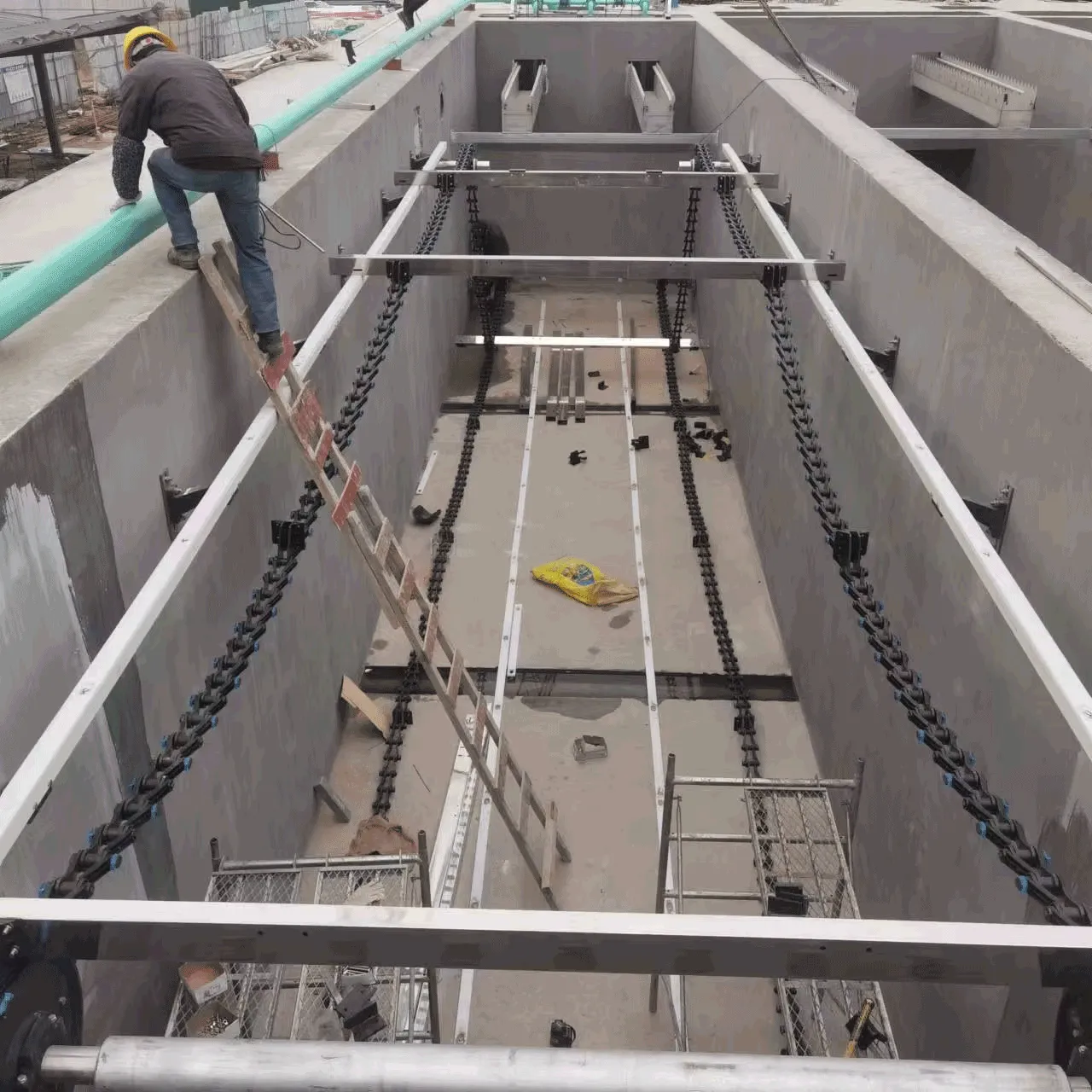
The Replacement Frequency Hierarchy in a Wastewater Plant
Sewage treatment plant equipment is replaced on a predictable hierarchy that every plant operator learns through budget cycles. At the top — the component consuming the largest maintenance budget share year after year — is the clarifier scraper system. Pumps follow. Aerators and diffusers follow pumps. Screens and grit removal equipment last longest. Understanding why scrapers lead the list requires understanding what attacks them.
Scrapers, Pumps, Aerators, and Screens — Mean Time Between Replacement
In typical municipal sewage treatment plant equipment, stainless steel scrapers are replaced or overhauled every 3 to 6 years. Submersible pumps last 5 to 8 years. Fine bubble diffusers degrade after 5 to 7 years. Bar screens last 10 to 15 years. The scraper replacement interval is half that of the next most-frequently-replaced category because scrapers operate at the clarifier's air-water interface — where corrosion from below and above concentrates.
Real-World Case — A Plant Operator Tracks 5 Years of Equipment Replacements
A 50,000 m³/day municipal sewage treatment plant equipment maintenance log tracked replacements from 2019 to 2024. Results: scrapers — three complete chain-and-flight replacements across four clarifiers (average 3.7 years per replacement), total cost €127,000. Pumps — two replacements (average 6.2 years), €34,000. Diffusers — one replacement across two aeration basins (7.0 years), €62,000. Screens — zero replacements. Scrapers consumed 57% of the major equipment replacement budget while representing 20% of equipment count. The operator partnered with HSHUAKE (Hengshui Huake Rubber & Plastic), an 18-year non-metallic scraper manufacturer, to replace stainless scrapers with composites. The first installation has operated 30 months with zero replacements — already exceeding the stainless average.
Why Scrapers Fail First — The Corrosion-Load Double Attack
Chemical Attack from Below, Biological Attack from Above, and Mechanical Stress
The clarifier scraper in sewage treatment plant equipment operates at the intersection of three destructive forces. From below — settled sludge contains 150 to 400 mg/L chloride ions and dissolved H₂S at 2 to 15 mg/L. From above — the headspace contains H₂S gas at 5 to 50 ppm, oxidized by Thiobacillus bacteria to sulfuric acid at pH 1.0 to 2.0 on tank walls above the waterline. Scraper chains crossing the waterline twice per rotation experience both attacks on the same component. Mechanical stress is continuous — 2 to 5 kN of chain tension moving settled sludge 24/7/365. No other sewage treatment plant equipment component experiences this combination.
The Scraper Component That Fails Most Often
Chain Links, Flights, Sprockets, and Wear Shoes — A Failure Sequence Analysis
The failure sequence in sewage treatment plant equipment scraper systems follows a predictable pattern. Chain links fail first — the waterline links where the chain transitions from submerged to exposed on every rotation develop chloride pitting on the submerged portion and sulfuric acid attack on the exposed portion. A single failed link drops the scraper flight, stopping the entire clarifier. Flights fail second — the structural connection between the two chain strands, carrying the scraper blade, experiences bending stress where sludge load concentrates mid-span. Sprocket teeth wear third — the chain pin sliding into and out of the sprocket tooth profile creates abrasive wear accelerated by grit particles embedded in the chain lubricant film. Wear shoes — the low-friction pads between the flight and the tank floor — last the longest because they are designed as sacrificial wear components. The material that fails first defines the replacement interval: upgrading the chain material from 304 stainless to glass-reinforced engineering plastic extends the weakest link's life by 3× to 5×.
Reducing Scraper Replacement Frequency
Material Selection, Preventative Maintenance Scheduling, and Design Upgrades
Three approaches reduce scraper replacement frequency in sewage treatment plant equipment management. Material selection — switching from 304 stainless to composite (glass-reinforced PA6, UHMWPE, or POM) for chain links and flights eliminates the corrosion mechanism entirely. Composite materials are chemically inert to chloride and sulfuric acid across the full wastewater chemistry range. Preventative maintenance — quarterly inspection of chain tension, sprocket tooth profile measurement, and wear shoe thickness measurement catches degradation before failure. A chain with 2% elongation has reached its wear limit; replacement at 2% prevents the catastrophic failure that occurs at 3% to 4% elongation. Design upgrades — replacing the metal-on-metal chain pin-to-sprocket interface with a composite pin on a compatible sprocket material eliminates galvanic corrosion and reduces abrasive wear. HSHUAKE supplies non-metallic scraper systems engineered for 10 to 15-year service life in municipal wastewater.
Frequently Asked Questions
Why do clarifier scrapers fail faster than other sewage treatment plant equipment?
Scrapers are the only sewage treatment plant equipment component operating at the air-water interface — submerged in chlorides and H₂S from below, exposed to sulfuric acid from Thiobacillus bacteria above, and under continuous mechanical load. HSHUAKE manufactures corrosion-immune composite scraper alternatives.
What is the most common scraper component failure?
Chain links at the waterline fail first in sewage treatment plant equipment scraper systems — they experience both chloride pitting (submerged) and sulfuric acid attack (exposed) on every rotation. A single link failure stops the clarifier.
How long should a sewage treatment plant scraper last?
A 304 stainless scraper in a sewage treatment plant equipment set lasts 3 to 6 years. A composite scraper system lasts 10 to 15 years in the same environment. HSHUAKE composite scrapers have demonstrated 30+ months with zero replacement.
What material upgrade reduces scraper replacement frequency most effectively?
Switching scraper chain links and flights from 304 stainless to glass-reinforced engineering plastic in sewage treatment plant equipment eliminates corrosion — the primary failure mechanism. HSHUAKE provides custom-dimensioned composite scraper systems.
How should scraper maintenance be scheduled?
Inspect sewage treatment plant equipment scrapers quarterly: measure chain elongation (replace at 2%), sprocket tooth wear, and wear shoe thickness. Annual comprehensive inspection with the tank drained. HSHUAKE provides maintenance scheduling documentation.
Can composite scrapers be retrofitted into existing clarifiers?
Yes. Composite sewage treatment plant equipment scraper components are custom-dimensioned to existing tank dimensions, matching sprocket center distance and flight spacing. Installation uses basic hand tools with no crane access required.